

The Universal Jesus Kingdom | Ancient Faith |
Advent Nativity Fast
A Convergence of Eastern and Western Theology
By ††Joshua Paul Logan, Sr.
The Universal Jesus Kingdom Ancient Faith Advent Nativity Fast represents a profound synthesis of the two great traditions of Christendom—East and West—uniting them into a single, holistic season of spiritual preparation. This observance merges the Eastern Orthodox emphasis on the Nativity Fast (or St. Philip’s Fast), a 40-day ascetic journey beginning November 15, with the Western Christian tradition of Advent, a season of expectant hope marked by candles and weekly themes beginning four Sundays before Christmas.
Historically, these two traditions shared a common origin in the early Church’s desire to prepare for the Feast of the Nativity, but they developed distinct theological accents. The East focused on the mystical reality of the Incarnation through ascetic discipline (fasting, almsgiving), realizing that “Christ is born” is an eternal truth. The West focused on the historical and eschatological “Coming” (Adventus), looking forward to both Bethlehem and the Second Coming (Parousia).
This article explores the history and theology of this convergence, illustrating how the “Universal Jesus Kingdom” perspective invites believers to live in the tension of the already (Christ is with us) and the not yet (awaiting His return), using the ancient tools of fasting, prayer, and charity to prepare the heart as a throne for the newborn King.
I. The Historical Origins: Two Paths to the Manger
The “Universal Jesus Kingdom” observance recovers the full, ancient timeline of preparation, which has often been shortened or lost in the modern era. To understand this convergence, one must look at the roots of both the Nativity Fast and Advent.
1. The East: The Fast of St. Philip (November 15 – December 24)
In the Eastern tradition (Byzantine, Coptic, and others), the preparation for Christmas is known as the Nativity Fast. It is popularly called St. Philip’s Fast because it begins on November 15, the day after the Feast of St. Philip the Apostle.
- Historical Development: In the early centuries, the duration of the fast varied by region. Some fasted for seven days, others for longer. The 40-day period was formally standardized at the Council of Constantinople in 1166. The council sought to mirror the 40 days Moses fasted on Mount Sinai before receiving the Ten Commandments.[1]
- Theological Rationale: As St. Symeon of Thessalonika wrote, “We, fasting for forty days, will reflect upon and receive from the Virgin the living Word—not written upon stone, but born, incarnate.”[2]
- The “Winter Lent”: Unlike the Western Advent, which emphasizes anticipation, the Eastern fast emphasizes purification. It is a tool to cleanse the “eye of the soul” so that the believer can behold the mystery of the Incarnation. The discipline is physical (abstaining from meat, dairy, and rich foods) to produce spiritual clarity.
2. The West: St. Martin’s Lent and the Rise of Advent
In the West (Rome, Gaul, Spain), the season developed differently but originally shared the 40-day structure.
- St. Martin’s Lent: In 5th-century Gaul (modern France), a fasting period began on November 11 (Feast of St. Martin of Tours) and lasted until Christmas. This was known as Quadragesima Sancti Martini (St. Martin’s Forty Days). It was a time of fasting three days a week.[3][4]
- The Shift to “Advent”: By the 6th century in Rome, the focus shifted from fasting to liturgical preparation. Pope St. Gregory the Great (d. 604) is often credited with structuring the season around the four Sundays preceding Christmas. The term Adventus (Latin for “Coming”) was adopted, translating the Greek Parousia.[3]
- The Candles: The Advent Wreath, a staple of Western observance, is a much later German innovation (19th century) that symbolizes the growing light of Christ entering the darkness of the world.[3]
II. Theological Convergence: The “Universal Jesus Kingdom” Perspective
The Universal Jesus Kingdom Ancient Faith Advent Nativity Fast bridges the gap between these two histories, creating a “Universal” or ecumenical approach that honors the fullness of the Christian experience.
1. The “Already” and the “Not Yet”
A critical theological distinction:
- Western View: “The faithful await the coming of Jesus… awaiting the Second Coming (Parousia).”
- Eastern View: “Jesus is already with us… ‘Lo, I am with you always’ (Matthew 28:20).”
The convergence of these views creates a powerful Kingdom tension. We do not pretend Jesus has not been born (mere historical reenactment), nor do we ignore that He is coming again (eschatology). Instead, the Fast serves as a re-alignment of our lives to the reality that the King is present in the Eucharist and the Church, yet we must still prepare the world for His final reign.
2. Incarnational Humility: The Fast as Imitation
The convergence theology reframes fasting not as legalism, but as incarnational imitation.
- Scriptural Basis: “He made Himself poor though He was rich” (2 Corinthians 8:9).
- Application: When we simplify our diet (fasting from rich foods) and our schedules (fasting from noise), we are physically participating in the poverty of the Cave of Bethlehem. The empty stomach becomes a space for the Spirit to fill.
- St. Paul’s Reminder: “The Kingdom of God is not food and drink, but righteousness and peace and joy in the Holy Spirit” (Romans 14:17). This verifies that the physical fast is a means to a spiritual end: the acquisition of the Holy Spirit.
III. The 2025 Observance: Dates, Themes, and Practices
Based on the convergence model, the 2025 season is structured to include the full 40-day ascetic discipline of the East while marking the weekly thematic progression of the West.
| Period | Dates | Tradition Source | Focus |
| The Fast Begins | Sat, Nov 15 | East (Fixed) | Beginning of 40-Day Journey; Feast of St. Philip |
| Thanksgiving | Thurs, Nov 27 | American/Cultural | Relaxation of Fast permitted (Feast Day) |
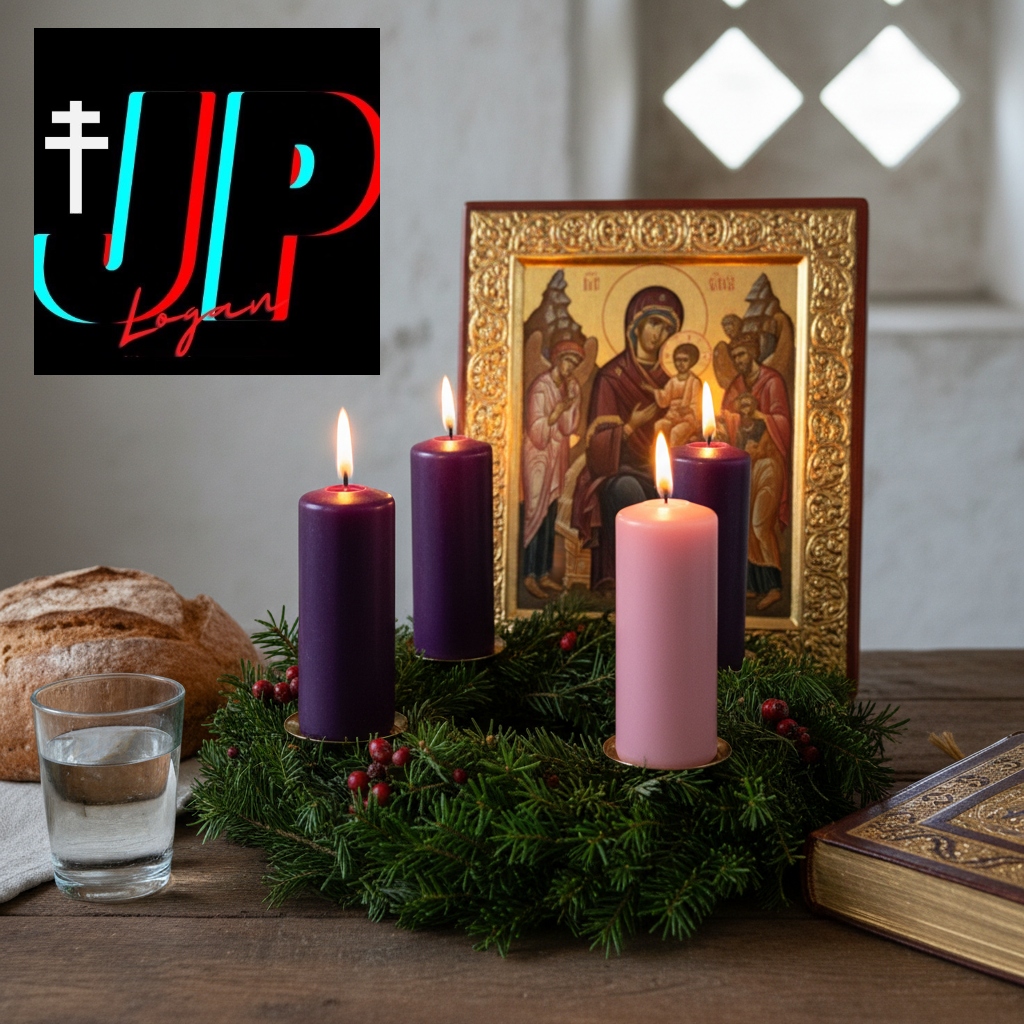
| Advent Sunday 1 | Sun, Nov 30 | West (Variable) | Hope (Purple Candle). The Prophecy Candle |
| Advent Sunday 2 | Sun, Dec 7 | West (Variable) | Peace (Purple Candle). The Bethlehem Candle |
| Advent Sunday 3 | Sun, Dec 14 | West (Variable) | Joy (Pink/Rose Candle). Gaudete Sunday |
| Advent Sunday 4 | Sun, Dec 21 | West (Variable) | Love (Purple Candle). The Angel’s Candle |
| Feast of Nativity | Thurs, Dec 25 | Universal | The Arrival of the King. (White Christ Candle) |
Table 1: 2025 Nativity Fast and Advent Calendar
2. The Fasting Discipline: “The Five Senses Fast”
Drawing from St. John Chrysostom, the Universal Jesus Kingdom Fast emphasizes that a change in diet must be accompanied by a change in behavior. This is often called the “True Fast”:
- Mouth: Abstaining from food and unjust criticism/gossip.
- Ears: Abstaining from listening to slander or idle talk.
- Eyes: Disciplining the gaze from sinful images or vanity.
- Hands: Ceasing avarice (greed) and practicing almsgiving.
- Feet: Ceasing to run toward sin and walking toward the neighbor in need.
“For what good is it if we abstain from birds and fishes, but bite and devour our brothers/sisters?” — St. John Chrysostom
3. The Kingdom Action: Almsgiving
The fast is explicitly linked to Kingdom benevolence. The money saved by restricting one’s diet (abstaining from meat, dairy, expensive lattes, and alcohol) is not meant to be saved for personal wealth but redistributed to the poor. This transforms the fast from a private spiritual exercise into a public Kingdom act of justice.
IV. Convergence Theology in Practice: What This Means for 2025
The Universal Jesus Kingdom Advent Nativity Fast is not merely an intellectual exercise in ecumenical theology. It is a lived reality that transforms how believers approach the Christmas season.
As articulated in the observance guidelines: 12 midnight – 12 noon (or later).
This partial fast allows for flexibility while maintaining discipline. Believers abstain from rich foods and animal products during the early morning hours, then may take a simple meal at midday or later. This mirrors the practice of the Early Church and contemporary Eastern Orthodox practice.
2. Health Considerations and Medical Wisdom
The fast is not a hunger strike. Those with medical conditions, diabetes, pregnancy, or other health concerns should:
- Continue prescribed medical treatment without guilt.
- Remove alternative, unnecessary items from the diet (soda, candy, desserts, fast food, excess caffeine) rather than essential nutrients.
- Consult with spiritual directors and physicians about appropriate modifications.
The Kingdom of God values the preservation of the body as a temple of the Holy Spirit, not its destruction.
3. The Nativity Prayer: The Heart’s Preparation
Every day of the fast, the faithful are invited to pray the Nativity Prayer:
Lord Jesus, You have come so many times to us and found no resting place; forgive us for our overcrowded lives, our vain haste, and our preoccupation with self. Come again, O Lord, and though our hearts are a jumble of voices and our minds overlaid with many fears, find a place, however humble, where You can begin to work Your wonder as You create peace and joy within us. If in some hidden corner, in some out-of-the-way spot, we can clear away the clutter and shut out the noise and darkness, come be born again in us, and we shall kneel in perfect peace with the wisest and humblest of men.
Help us to enter into this Christmas Fast with humility yet with You. And, finally, Lord, give us Christmas from within that we may share it from without, on all sides, all around us, wherever there is need. God help us, every one, to share the blessings of Jesus in Whose name we keep Christmas holy. Amen.
This prayer encapsulates the entire theology: a heart preparing a manger for the King, emptied of self-preoccupation and filled with the Holy Spirit.
V. The Kingdom Vision: Resurrection of the Ancient, Renewal of the Modern
The “Universal Jesus Kingdom” approach to the Nativity Fast is fundamentally about recovering the ancient faith while remaining prophetically contemporary.
1. Counter to Consumer Culture
In a world obsessed with Black Friday, Cyber Monday, and holiday shopping, the Nativity Fast stands as a radical “No” to consumption and a radical “Yes” to contemplation. When society urges us to buy, we give. When society urges us to feast, we fast. When society urges us to rush, we rest.
This is not escapism; it is Kingdom resistance—the practice of citizens of another realm living according to different values.
By honoring both Eastern and Western traditions, the Universal Jesus Kingdom observance models the kind of Christian unity Jesus prayed for in John 17. It says: The Eastern Orthodox are not wrong; the Western Christian is not wrong. Both are incomplete without each other.
The East’s wisdom about the mystical reality of the Incarnation must partner with the West’s wisdom about eschatological hope and historical promise. Together, they form the whole Gospel.
3. A Fast That Leads to Feasting
The ultimate goal of the 40-day fast is not deprivation for its own sake, but preparation for the greatest feast: the Nativity of the Lord. By December 25, the believer arrives not as a consumer ready for another transaction, but as a child ready to be born anew in Christ.
The fast is the wilderness journey; Christmas is the promised land.
The Universal Jesus Kingdom Ancient Faith Advent Nativity Fast is an invitation to enter the “Cave” of the heart. By beginning on November 15, the believer rejects the secular “holiday rush” that celebrates consumption and instead enters a quiet, 40-day desert. By marking the Sundays of Advent, the believer joins the universal Church in lighting a candle against the darkness.
As the user’s text beautifully summarizes: “Nativity is not only about God’s coming down to us, but about our rising up to Him.” This 40-day ladder of ascent—built on the rungs of fasting, prayer, and charity—allows the faithful to arrive at December 25 not merely with gifts in hand, but with a heart prepared to receive the King of Kings.
In the Universal Jesus Kingdom, we practice now what we will perfect in eternity: a life centered entirely on Jesus Christ, crucified, risen, ascended, and coming again. The Nativity Fast is our annual rehearsal for that kingdom.
“Lo, I am with you always, until the end of time.” (Matthew 28:20)
[1] Barriger, Fr. L. “The Nativity Fast – Orthodox Christianity Then and Now.” John Sanidopoulos, 2010. https://www.johnsanidopoulos.com/2010/12/nativity-fast.html
[2] ByziMom. “November 15: Observing the Nativity Fast.” ByziMom, 2019. https://www.byzimom.com/post/november-15-observing-the-nativity-fast-abstaining-and-the-jesse-tree-devotion
[3] Alexander, J. Neil. Waiting for the Coming: The Liturgical Meaning of Advent, Christmas, and Epiphany. Oxford University Press, 2011.
[4] “What is the History of Advent?” First United Methodist Church Titusville, 2024. https://www.fumctitusville.com/uploads/2/4/6/1/24617910/december_2024_messenger_1.pdf
[5] Sanidopoulos, Fr. John. “Why and How We (Copts and Eastern Orthodox) Fast Before Nativity.” John Beloved Habib, 2014. https://johnbelovedhabib.wordpress.com/2014/11/25/why-and-how-we-copts-and-eastern-orthodox-fast-before-nativity-christmas/
[6] Orthodox Christian Tradition. “The Nativity Fast: Philip’s Fast.” St. Michael’s Byzantine Catholic Church, 2025. https://stmichaelsbyzantine.com/our-traditions/the-nativity-fast-philips-fast/
[7] “A Short Explanation of the Weeks of St. Philip’s Fast.” Eastern Catholic Eparchy, 2021. https://eeparchy.com/2021/11/03/a-short-explanation-of-the-weeks-of-st-philips-fast/
[8] “The Nativity Fast in the Orthodox Church: Christmas Fast Rules.” Obitel Minsk, 2023. https://obitel-minsk.org/nativity-fast-plan-meals-rules
[9] Metropolitan Tikhon. “Reflection on the Commemoration of the Holy Apostle Philip.” Orthodox Church in America, 2023. https://www.oca.org/reflections/metropolitan-tikhon/reflection-commemoration-holy-apostle-philip
This article was written in service to the Universal Jesus Kingdom Convergence Movement, with theological guidance reflecting the convergence of Eastern Orthodox and Western Christian traditions. May it serve to strengthen faith, inspire repentance, and prepare hearts for the Nativity of our Lord Jesus Christ.
Promised Land Ministries, Inc.
“Kingdom Community Collaboration – God Without Walls”
“Earnestly Contending for the Unity of the Ancient FAITH through CONVERGENCE”
Matthew 16:18 Psalm 133:1-3, Ezek. 37:15-17, John 17:20-23, I Corinthians. 1:10, Ephesians 4:1-7, & Jude 1-4 & 17-25
“Upon This Rock, I Will Build My Church, and The Gates of Hell Shall Not Prevail Against It!” ~ King Jesus
